What do Nine Inch Nails tunes and the Barney theme song have in common? In addition to Reznor's and the dinosaur's penchant for purple velvet, they both share the unfortunate commonality of torture.
As I chronicled in a series of posts from last April, the US military and intelligence services have been using music as a weapon of torture with imprisoned "foreign combatants" since the invasion of Iraq and the opening of Guantanamo. Today, however, it was reported that musicians whose music was used in these enhanced interrogations are organizing and fighting back (including angsty NIN frontman Trent Reznor, Massive Attack, former Rage Against the Machine guitarist Tom Morello, and a crew of children's song writers).
More on this development here.
Showing posts with label Culture. Show all posts
Showing posts with label Culture. Show all posts
Wednesday, December 10, 2008


Tuesday, November 25, 2008
A Blood Thirsty Biochemical Explanation
During this summer, I was preparing myself for medical school by doing foolish things- I read a popular teen vampire novel called Twilight. This week Twilight the movie premiered, although I haven’t had time to go see it yet. However, it was during this same week at one of my final biochemistry lectures that I learned something very interesting and unexpected… vampires are real!
What?! Why didn't I hear about this disease before? Oh yes, that’s probably because people who actually have this genetic disease would rather not be related to vampires. Given that vampires are considered evil by many people and were tortured outcasts of society, this is a touchy subject. The legend of vampires exists nevertheless, and there is a real medical explanation for how it may have originated. Therefore, I feel compelled to share this intriguing knowledge.
It makes sense that before science was able to explain strange genetic diseases and symptoms, people assumed that they were connected with the devil or a result of certain behaviors or diet. In fact, when I lived in rural Ukraine, pregnant women refused to cut their hair, thinking it would cause birth defects. Yet, now we know that genetic defects are often the result of a tiny, unlikely mistake in the duplication & division of DNA. A single tiny rearrangement or deletion can cause a lot of strange things to happen- it’s amazing that most of us come out looking “normal.”
The possible explanation of the vampire legend is one of seven types of porphyrias, which are all diseases in the synthesis of heme (the compound in blood which carries oxygen and carbon dioxide to keep us alive). Heme is synthesized in the liver and bone marrow. There are eight steps, four of which take place inside mitchondria and four in the cytoplasm. Therefore, there are multiple opportunities for defective enzymes and build up of intermediate products.
The interesting thing about the intermediates in heme synthesis is that they contain many benzene rings. When these rings are oxidized, they can absorb light and appear to be colored (think of purple-yellow-brown-greenish bruising when heme is broken down right under the skin). When there is a build up of intermediates, it causes purple urine, red and fluorescent teeth, and extreme sensitivity to light rays.
The type of porphyria believed to have started the legend of vampires is called porphyria cutanea tarda. It leads to a build up of products which cause a variety of problems. First, people suffer from extreme anemia, so they are very pale. Additionally they have red and fluorescent teeth, which can look pretty strange. The intermediate products in their blood can oxidize to become insoluble when exposed to sunlight. This causes pain and blistering in their skin, so they would try to never go outside in sunlight. Also, drinking fresh blood, which somebody may have figured out, could relieve the neurological symptoms. This was a genetic defect, so it stayed within families. Since these people were probably outcasts from society, they may have married cousins causing the disease to proliferate faster.
None of this is proven fact because nobody knows where any supposed “vampires” are buried. Otherwise, it would be possible to dig them up and perform a genetic test. Also, this explanation doesn’t explain a fear of garlic or why you have to put a stake through their hearts to kill them. This is an extremely rare disease. Yet, it’s interesting to know that we understand so much about the body now that we can go back in time to solve medical mysteries.
Friday, November 7, 2008
From 52 to 48 with love

There's a poignant and telling project going on in a certain quiet corner of the Internet. View love letters from the 52% of blue America to the 48% of red America (and vice versa) here.
The World's President: Part 1 - Hope
Since Barack Obama's stunning and monumental election as president earlier this week, Americans have started to repair the shame that has accompanied their nationality for years. Americans living in Berlin and Paris were out in the streets early Wednesday morning proudly displaying the flag; being an American in the world suddenly stopped being a liability and became an object of celebration. And the rest of the world reacted to the news in a similarly jubilant fashion. "Hope" and "Change," those buzz words of the long campaigning process, took on a radical new meaning and were handily yanked from the abstract when we saw a black American family take the stage in triumph, joined later by the Biden clan. Watching this group of Americans - black and white - appear before the nation was not simply a victory for the Democrats, nor was it only an "historic" moment, as we've heard time and again in post-election wrap-ups. The election of Barack Obama was a triumph for humanity.
This probably sounds grandiloquent. And naive. "It is the mark of inexperienced youth," some wag once said, "to read one's own historical moment as completely unique." With full knowledge that history moves along slowly, with fits and starts, and that it is constantly repeating itself, I also recognize that there are moments that come along every so often that change the game entirely. Often these events are technological: the invention of the printing press, for instance, ushered in a whole new era in the way humans communicate. Other times they are cultural: the writing of the US Constitution inaugurating this model of government, for instance. History trudges along slowly, but occasionally a power surge flows through the machine and forces its gears to speed things up. I believe that this election will be remembered as one of these moments, not just as a country but as a species.
Since the beginning of the colonial era, black people across the globe have been systematically kept from attaining real power. Perhaps the most emblematic story of this failure is the nation of Haiti, the world's first independent black country. Upon pushing out the French, the Haitians were left with only one option to regain stability: trade with France, who had made the colony the wealthiest in the New World. Alone in the world, isolated by oceans, Haiti needed diplomatic recognition and trade to prosper, but France would not grant them this privilege until they paid a huge fee (reparations, really). This debt crippled the nation from the very beginning, making it virtually impossible for them to succeed in any meaningful way. Add to this the symbolic import of an independent black country and what it came to represent for slaves throughout the New World, and you can see that the very idea of Haiti was profoundly destabilizing. For this reason, the United States has kept the country on a short leash for over a century, at times occupying it with Marines for years on end. Most recently, in 2004 the democratically elected and highly popular leader Jean-Bertrand Aristide was removed from power and essentially kidnapped by the US Military and sent to live in exile in South Africa.
I relate this truncated history of an unfortunate nation because it is, essentially, the story of black people the world over. Both within the United States and on the global stage, people of African ancestry have been marginalized and kept poor, uneducated, and unhealthy. Naysayers to this claim might argue that the intense tribalism within Africa has led to the continent's endemic cycle of poverty and politico-economic instability. Arguments made on these cultural grounds, however, really don't carry too much weight: for years in this country, the disadvantaged status of black Americans was all too often chalked up to "laziness" and other demeaning cultural excuses. While I certainly wouldn't put blame for the failure of black ascension entirely on the shoulders of the rich world, I would say that this is the major culprit for why the situation is as it is today. As the story of American slavery has taught us, it takes centuries to heal these sorts of wounds; in Africa, the wounds come from a colonial past. The current state in sub-Saharan Africa, with Somalia controlled by militias, Sudan engulfed in an ongoing genocide, Congo teetering on the brink of another devastating civil war, and Zimbabwe collapsing, is not just a tragedy for Africans - it is failure of humanity.
The ravages of poverty are just as much psychological as they are physical. What must it be like to look around the world and see not one single majority-black nation really succeeding on the global stage? (Perhaps with the exception of South Africa, who built its economic power over its years of white rule.) How would it effect you if the only wealthy people you saw who looked like you were athletes and rappers? A friend who lived in Cameroon told me that she was dismayed to learn that there is a lot of anti-black racism within African nations: professors at the main university in Yaounde told her that clearly there was a difference in intelligence between the races. The evidence? "Just look at the world. We are poor everywhere - you are rich," they told her.
The word "hope" must have an entirely different ring for individuals and nations that have come to accept the fact that they will always struggle. Obama's meteoric rise and victory has demonstrated something incredibly profound - in a world where "black" and "Africa" are virtually synonymous with poverty, AIDS, military coups, and a host of other crises of humanity, one man - with black African roots - has risen to lead the world's most powerful nation. The symbolic import of this moment very well might, I believe, cause a shift in the machinery of human history. It has the potential to fill millions of souls with hope, purpose, and greater collective self-worth. (This goes for people of all colors and creeds, of course.) But for a black person, the significance of this moment must stand as a game-changer.
Yes we can.
Friday, October 10, 2008
Idiocracy
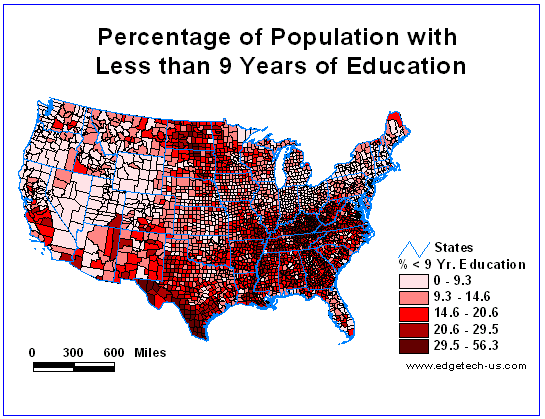
Since many of us were born, the American political map - with blue states on the coasts and Great Lakes region and red states everywhere else - resembled many other maps showing different aspects of American culture and economy. It roughly correlates to the map of obesity rates, with red states being fatter than blue ones; it matches the prevalence of Wal-Marts in US communities; it matches a map of US education levels. Are Republicans really fatter, more prone to shop at Wal-mart, and less educated than their Democratic peers?
Increasingly, yes they are. In today's NYT David Brooks published a revealing article on the shifting culture of political conservativism. When the modern conservative movement started, it was intellectually radical, challenging the status quo academic thinking regarding taxation, the role of government, etc. Its leaders, while weary of the liberal, Ivy League elite, also valued education, achievement, and intellectual rigor. This was the conservativism of William Buckley: populist but sprinkled with erudite sesquepedalianism. Through the mid 1980s, THIS was the conservative moment, and its appeal was broad - in 1984, Reagan took every state but Minnesota. But soon after Reagan, the GOP began to undermine this loose coalition of urban conservative intellectuals and rural voters. Instead of taking on just the liberal academic elite, they began taking on educated, coastal people in general. "Elitism" was not just used to describe liberal NYU sociology professors: it was used to describe any Californian with a good education and relatively high salary. This bargain had a Faustian tone to it: as the shift occurred, most of the intellectual muscle of the United States fled the conservative movement. Now, all the states with the most money (save Texas) are Democratic; lawyers donate to the Dems at a rate of 4-to-1; doctors, 2-to-1; tech workers and executives, 5-to-1; even those in the financial industry, those stalwart Wall Street Journal readers, donate a lot more to the Dems (2-to-1).
What is happening here? I propose two explanations, the first political the second more philosophical. A big reason for this massive shift in allegiances, of course, came about in GOP strategy think tanks. It was observed - and rightly so, as Karl Rove has demonstrated - that if the mass of relatively uneducated, southern and western Evangelicals can be mobilized, they will overwhelm the coastal "elites" in the electoral college. The electoral map from 2004 is stunning: virtually the entire mid-section of the country is red. Although these were the regions affected most by Bush's Iraq War, were decimated most by trickle-down economics, were - in short - losing more from conservative policies than the coasts, these were precisely the people voting the bums back into power. Thomas Frank's great book "What's the Matter with Kansas?" is an intriguing meditation on this important question: why do so many people in red states vote against their own economic self-interest? The answer, of course, are the ever-raging culture wars and the GOP's shrewd manipulation of them to get out the vote while never actual making a dent in the actual issues value voters care about. Herein lies perhaps the biggest stroke of political genius of the last 20 years: divide the people along cultural lines, invent issues that stir up emotional responses, and let the idiots duke it out with the "coastal elites." Joe Six-pack will inevitably overpower the tweed-wearing snob.
This is the political reality of the shift. But there is also an underlying philosophical transformation going on here. Backing up a bit: I've always leaned Democratic my whole conscious life. Indeed, one's family is the greatest predictor of political bent and my family has no shortage of "libruls." However, even in high school and before, I always understood and respected the conservative position. I didn't necessarily agree with it, but it was a consistent, rigorous philosophy with its own logical contentions, approaches, and solutions. Of course, this form of conservativism - the one that makes sense - it still out there. I consider George Will and David Brooks, for example, to be smart, principled conservatives. I don't always agree, but I always read their columns. Pat Buchanan, despite occasional forays into extreme right-wing cant, generally fits into this category as well. But David Brooks doesn't set the political agenda in small towns in Ohio; George Will isn't a commentator on FOX News; Buchanan is far more active on public broadcasting than he is in the screaming head, vitriolic media so frequented by red America. Politics aside, as all of the aforementioned conservatives agree, Republican ideas are in a state of emergency. Real world facts have changed but conservatives keep pounding home the same points they've anchored themselves to for years: cut taxes, keep military spending high, half-assedly pursue "cultural" issues, distrust "Big Government" (what about "smart government"?), etc. ad nauseum. Watching Palin speak is a exercise in beating a dead horse - although the world has changed, the talking points remain the same. The Republican philosophy is starting to rot.
Frankly, I don't understand how anyone can look at the hard realities facing us today and believe that the modern Republican message addresses them at all. I understood back in 1998 - I'm at a loss now. Barring those individuals who will vote for whoever says they're pro-life or pro-gun or anti-gay, the facts are so clearly in the Left's favor that it's a miracle the GOP is still hanging on to 43% of the popular vote. The list is way too long to list here, but over the last eight years many sacred cows of Republican thinking have been completely discredited. The failed wars show the limits of American military power and the tragedy of Empire; the ongoing economic crisis shows the complete failure of deregulation to create a fair, balanced financial system; the $10+ trillion debt shows us the unsustainability of tax cuts to the rich and spending beyond our means. (Ironic that conservative presidents have rung up such obscene deficits in the last 25 years.) The list goes on.
I've come to a certain conclusion: as conservative principles have begun losing their power to express the world, those who know better - ie., the educated coastal "elites" - have fled. Despite the handful of smart conservative analysts, scholars, and writers keeping the old intellectual revolution alive, the primary voices of the movement now are Sean Hannity, Rush Limbaugh, Bill O'Reilly, et al. THEY are the ones driving opinion in rural red state areas, not the aristocratic William Buckley. As conservative principles have lost their intellectual power, therefore, the GOP has resorted to the only reasonable strategy they can adopt to maintain power - hoodwink stupid people into voting against their own interests. The ideas can't stand up on their own, but if you get Hannity screaming about the liberals coming to take away your American values, then you might get some traction. The GOP today relies not on southerners, Joe Six-packs, or Christians - it relies on stupid people.
Update: The conservative Wick Allison's assessment of conservativism is right on the money.
Update II: And another recent Op-ed piece by Bob Herbert that amplifies the argument here.
Friday, October 3, 2008
A German View on America
An American friend recently asked me how Americans were currently perceived in my home country, Germany. He figured that the image of the “Amis”, which is what we like to call US citizens, was still affected by the alarming proportions of the war on Iraq. Now, one thing I am absolutely certain of is that Germans never directly made your citizens responsible for the war. We only criticized your government (which was - and is to this day - a legitimate thing to do).
Having lived in the United States for some time, I found it difficult to give my friend an untainted answer to his question. So I decided to initiate a small survey, asking friends and family back home about what they think of Americans today. The results were both funny and serious. Some answers were very much expected, others were quite surprising.
Here are some of the answers that most of them would give me, whether they have been to the United States or not. Number one: Americans are fat. (They didn’t say “big-boned”. They actually all said “fat”). Number two: Americans are stupid. (Not “uneducated” – “stupid”). And Number three: Americans are all armed to the teeth.
Are these answers surprising? Probably not. Clearly, all three opinions display another stereotype about the American people. But isn’t there some truth to every single one of them?
Like so many other things in the USA, education is really only good if you can afford it. Unfortunately, this leaves many young people behind when it comes to receiving proper education. So it’s not fair to say that it’s their fault to be “stupid”. However, what I have experienced in America so far is that people are extremely curious about other cultures. I am constantly asked what life in Germany is like. Even if some of these questions can be incredibly ridiculous (Do they have electricity in Germany?), it still shows that there is a natural curiosity. The only problem is: The average American has no access to relevant information. The local news channel prefer to cover stories on crime and rape rather than foreign affairs. In school, US History is often more important than World History.
A similar account can be made for the obesity of the American people. That Americans are way too – sorry – fat cannot be denied. But it is really not surprising. Just take into account that you’ll get a hamburger for 49 cents at your local McDonalds but pay $1.29 for an apple in the grocery store (Good luck finding an apple that actually tastes like an apple). At a time of economic despair like today, the lower and middle class have little choice but to eat cheap junk food rather than an expensive home cooked meal. No wonder that all of the 50 American states have obesity prevalence rates of more than 20 percent. That’s a lot of body fat.
Some Germans also pointed out that the USA is full of opposite extremes. So for every obese person out there you can probably find one super fit, athletic, tanned and oiled person out there. “There is no healthy balance,” says one friend. You can find the same double standard when it comes to sexuality and alcohol. No one talks about sex, every one has it. Teenage pregnancies are the result. You can’t buy alcohol under the age of 21. Teenage kids develop the hobby of binge drinking.
That Americans love their weapons is a well known fact throughout the world, and it is also the one thing we cannot help but laughing at. The idea that every person should have the right to defend themselves and their property and is therefore allowed to keep a gun in their house, is nothing but ridiculous. Oh wait – it is also pretty scary. Unfortunately, a student running amok is no longer an American phenomenon. At this point, Germany would like to thank you, America, for this new export item!
Now let us not be too harsh on the American people. In my survey, there were also a lot of good things being said about America. Most of those Germans, who have actually been to the USA before, said that Americans were always very friendly and helpful. Coming from a country where fellow citizens think you are crazy when you initiate a conversation with someone you don’t know, I would have to agree with my friends on their perception. Americans are probably the most polite, obliging and outgoing people I know. This attitude is often perceived as a form of superficiality, probably because Americans immediately call everyone they’ve just met their new “friend”. In Europe, it takes a little longer to earn that classification. Over here in the US, however, people just randomly start talking to you on the bus or in the streets and if you look lost, someone will immediately offer their help. In Germany, it’s every man for himself.
The current state of the American economy appears to bring up two notions in the mind of the German people. On the one hand, we are extremely worried about the extent of this downfall and how it will affect our own economy. Its dimensions can already be felt on a daily basis in Germany. The sad thing: our economy was only just recovering from the 90's aftermath of the German reunification. And now it's blown into pieces just because some people over here feel the need to live their lives beyond any reasonable scale. This leads us to the other notion: Schadenfreude. For years and years Americans bathed themselves in their blooming economy, not thinking further ahead than to next month’ credit card bill. Some Germans, especially those of a younger generation, fell that America's arrogance and recklessness is finally getting its payback.
Patriotism is a concept very much surreal to the German people – for obvious reasons. When we visit the USA, the first thing we notice are the flags in your front yards and on your cars. United they stand – for better or for worse. But it is this patriotism that we feel is often misused by those in power. “Americans are very easily manipulable,” says another friend of mine, referring to the fact that many don’t question what the government and media tell them. Germans are very much aware that the constant threat of evil many Americans fear is a result of Washington’s manic propaganda. Last but not least, we’re all pretty much staggered when we see an American’s obsession with religion. And we can’t help but wonder if it is actual belief – or pure show. That politics and religion go hand in hand is also very disturbing.
I have to admit that, in my survey, I mostly interviewed people my age. So I was thankful when one of my friends was able to get her grandmother, Inge, to offer her opinion. Inge is 80 and has experienced the Allied occupation in Berlin at the end of WWII. “I am deeply grateful to America,” says Inge. “During the occupation, West Berlin could only be supplied through the American airlift. I won’t ever speak ill of the American people.”
One thing I have to mention about everything that’s been said so far. Many of my and my friends’ opinions are based on stereotypes and they are oversimplified. There’s plenty to analyze and to elaborate on. We might laugh at your country a whole lot, but we’re also very fascinated by it. The truth is: Whether good or bad, we copy pretty much everything you guys do. We also follow your current affairs and politics with eager eyes. Germany is very excited about this young and dynamic presidential candidate of yours, hoping that America will make the right choice in November. In this spirit, there is nothing left to say but: God help America!
Tuesday, September 16, 2008
Expanding Waistlines
It's easy for those of us who live in major metropolitan areas on the "liberal coasts" to forget. But head out into many communities in the US (or simply your local Walmart) and you'll get an idea of the extent of the problem. Last month, I left the cultural bubble of the Miami area and drove north into the South, to Orlando. I know the stats about obesity in America, but it was still startling to get back into a more "typical" area again. We are a nation of incredibly fat people.
One moment in Disney World really epitomized the state of the collective US waistline, and our eating habits in general. In the restroom at a buffet restaurant, I entered to find a father and his son standing in line to use the stalls - both of them were incredibly fat, and the father actually had food smeared all over his shirt, like a baby without a bib. I could hear the sound of someone throwing up in the bathroom. As I was washing my hands, the person in the stall came out - an obese kid of about 12 - and waddled over to the father and son. "You all right, buddy?" asked the father. After another stall opened up, the father and older son took leave of the youngster, closed themselves into the two adjoining stalls, and both proceeded to puke their guts out in unison. After that collective family purge, they were probably back at the buffet line.
Anecdotes aside, the stats on America's decline into obesity are truly shocking. In 1985, when I was four, only eight states had an obesity rate of 10-14%, the highest level of the day; today, not a single state has a rate that low. In 2008, three states have an obesity rate of around 30% (Alabama, Mississippi, and Tennessee); the majority are in the 25-29% range. And a quick definition of terms here: "obese" refers to someone with a BMI of 30 or more: when merely "overweight" people are factored into the equation (BMI of 25-29.9), the national percentage is a staggering 66%.
You might ask: "Zach, why do you care how fat other people are? They don't effect you - mind your own business." Our national obesity epidemic very much effects me, however; if effects every American, regardless of what pants size we wear. I don't hope to take on the whole issue here (I hope other writers will jump in and help me out on that count), but I would like to address two costly components of the obesity problem. Our increasing waistlines are both a public health disaster and an act of environmental irresponsibility.
Despite all the fancy dieting techniques and expensive surgeries out there to help shed some pounds, the trick to weight loss is stupidly simple: eat a balanced, nutritious diet and exercise regularly. A doctor a hundred years ago could have given the same advice, but it's disturbing now how illusive this solution is to many people. Instead of following these two simple strictures - which would require changes in lifestyle - people are instead turning to "something for nothing" schemes to make themselves healthy without making any real sacrifices. Not only is this dishonest, it doesn't work. Moreover, it is an abdication of responsibility for the root causes of the affliction in the first place: gluttony and sloth. That may be politically incorrect - some might even say "fattist" - to say, but that's the truth, folks. Barring thyroid conditions and other legitimate medical problems, obesity is entirely a choice.
In extreme instances, overweight people have tried to place the blame for their conditions on others, most notably the class-action lawsuit against McDonald's in 2004. Thankfully, the judge laughed at the argument that McDonalds is to blame for making you fat, effectively setting a precedent that a lawsuit of this nature is the very definition of frivolous.
There is a creeping danger in the obesity stats beyond the obvious the health problems associated with the condition. The more something becomes "normal," the less inclined people are to recognize it as a problem. In Mississippi, where 1 in 3 people is categorically obese, where is the motivation for losing some weight? Also, as my Disney story suggests, weight problems very often run in the family: if your whole community, included your sister and your father, are fat, then what's wrong with being fat? This perpetuates a false sense of security about the very real risks associated with obesity. And the risks are many. For example: type 2 diabetes (an epidemic now), hypertension, osteoarthritis, high cholesterol, heart disease, increased risk of strokes, gallbladder disease, sleep problems, and even some forms of cancer.
Treating an ailment which is entirely within the control of the individual has put a huge strain on our health system. According to a recent study, obesity costs health care providers (and taxpayers) $61 billion annually; it also costs the US economy $56 billion annually in indirect expenses (loss of productivity, etc.). For those of us who think that the explosive increase in fat people only affects those with the big guts, think again - your health insurance is as high as it is, in part, because of the diabetes treatments you're subsidizing for an obese woman in Birmingham.
Recently, in fact, the state of Alabama (#1 in obesity) has adopted a measure that requires obese state employees to pay a monthly fee for the health insurance that would normally come free in their payment packages. It is encouraging news: those who bring increased liability into an insurance risk pool should contribute more to it. We don't let smokers off the hook for their habits, and we shouldn't let obese people either.
Another important component of obesity is its effect on the environment. Like our fuel-consumption habits, Americans eat more than any other nation in the world. But as the world becomes increasingly more crowded and resources grow scarcer and scarcer, we can't keep eating like hogs. The Earth Policy Institute estimates that the average American eats the equivalent of 800 kilograms of grain per year (100 directly, as bread, pasta, etc., and 700 in the form of feedstock for cows, pigs, etc.). Let's contrast that with a couple other countries: Italy, by comparison, consumes 400 kilos per person. Indians eat 200 kilos of grain per year. In the words of EPI director Lester Brown, it's time for Americans to move down the food chain.
A couple of conclusions emerge from this data: 1) we eat too much in general, and 2) we eat too much meat. Neither of these things is good for our individual health, and as it turns out, it's not good for the planet either. In the last fifty years, world meat consumption has gone from 44 million tons a year to 240 million tons, more than doubling consumption per person. And with more livestock, we have more of the problems associated with it: deforestation, overgrazing leading to erosion, huge amounts of methane gas (20 times as potent as CO2), pollution to water sources, etc. It is also an incredibly inefficient way to get nutrients, as 7 kilos of grain are required to grow 1 kilo of beef. With populations growing and forests shrinking, is a fiercely carnivorous diet really that wise anymore? Eating lots, with plenty of meat, is unsustainable both from a personal and a global perspective.
Combating deeply ingrained eating habits will be difficult. Despite rises in the prices of staple foods over the last couple years, the obesity rate has remained unaffected, so entrenched are our current eating patterns. We've come to expect huge portions at our restaurants, and retreating from this ideal will take some getting used to. But we're going to have to suck in the gut and deal with it.
To me, one of the big reasons the obesity epidemic has gone unchecked for so long is because of mass complacency. The more fat we become, the more acceptable it is to be fat. I don't suggest socially stigmatizing overweight people per se, but I do believe that we need to recognize the problem for what it is - obesity is not simply a voluntary choice that should be respected: it is a destructive and unsustainable lifestyle.
Update: Here's some great commentary about our current eating problem by a NYT food writer. A bit long, but well worth the time. Thanks for the link, mFin!
Saturday, September 6, 2008
The Much-Coveted "Hockey Mom" Demographic
Latest Poll Reveals 430 New Demographics That Will Decide Election
From "lunch-bucket Democrats" and "latte liberals" to my new favorite, "hockey moms," we've been loaded up with an earful of demographic data on what sliver of the American public is going to decide this election. The Onion clip above illustrates this sort of pseudo-scientific attempt to predict voting habits beautifully.
Now, I have nothing against hockey moms. To me, this term has zero significance because, like the vast majority of Americans, I don't have any opinion whatsoever about the sport of hockey. Which begs the question: exactly what percentage of the American public are self-identified "hockey moms"? What political dividends is it paying for Sarah Palin to wear that demographic label so proudly?
No disrespect to the denizens of "the Great State of Alaska" or any of the other regions lying at a latitude northerly enough for ice hockey to be a viable sporting option. Nonetheless, this population of individuals is dwarfed by, say, the good ol' "soccer mom" demographic, let alone all the "tennis moms" and "T-ball dads." As a percentage of our total population, "hockey moms" are probably about on par with "racquetball grandmas."
Yet at the RNC one could see numerous "Hockey Moms for Sarah Palin!" signs in the audience. Since most of these people were probably not real "hockey moms," what is it that's so appealing about everyone's favorite new demographic? Is it simply a colorful biographical detail that people have jumped on? Or did the GOP really truly find the Holy Grail of voter demographics?
Beats me. You can bet one thing for sure, though: "hockey moms" are a much more patriotic and all-American group than volvo drivers, latte drinkers, and granola eaters. They're certainly more American than music editors.
Monday, August 18, 2008
The Middle Kingdom at Middle Distance

If I looked too closely, the sheer number of faces and smells and textures and motions and details, each worth exploring more fully, was overwhelming. My brain started to fizzle, watching a stream of people on bicycles passing and wondering about each one's family and ambitions and destination and history.
But if I mentally backed up too far, the thickness of all those layers of meaning made it hard to see individual humanity clearly. The people on bicycles became merely obstacles to dodge while attempting to cross the street, all the while wondering how many well-meaning tourists had met their demise that way.
I did make it to the Great Wall as promised. Two days early, in fact. After all that talk and thought, it was a bit strange to be there at last. We hear so much about the Great Wall of China—that famous thing about being able to see it from space, and the tales of its construction and defense all those centuries ago. (The part we visited was so impossibly steep that I couldn't help but wonder how many unfortunate Chinese soldiers had broken their legs or backs running around on it in the dark.) With the weight of all these stories surrounding it, the actual physical fact of the wall is a hard thing to get your mind around. From far off, the long pale line of it snaking over those dry, empty hills seemed too delicate a thing to have withstood all those years and all that history weighing down. Up close, it was merely stone and angles, strong and pedantic and weathered.
The importance of the place seemed to live in the middle distance, somewhere between its legend and the swarms of sneaker-clad tourists scrambling along it on that particular dusty, windy afternoon. For me, standing there was an acknowledgment of a dream realized, and one more entry for my list of traveler's bragging-rights. But it was also a symbolic place, where the lesson that China taught me was made suddenly clear.
Finding that observational middle distance is always a challenge for a traveler, and never more so than in the Middle Kingdom. Attempts at objectivity fail, and rightly so. All we can really do is compare the place we're discovering to the places we know, and discover something about both of them in the process. Carrying home the space between, that elusive middle distance, is as a good reason to go traveling as any I know.
I stood still for a long moment with those famous stones under my feet, watching a small dark-eyed girl and her brother playing tag between the lookout towers and feeling the wind move through my hair. Then Leon said, "Let's go get some dumplings." So we turned, and started the long climb back down.
Wednesday, August 6, 2008
To China, With Love
Journalists like to talk about "time pegs," by which we mean periods during which the general public might suddenly be interested in a particular subject. Anniversaries are good ones, as are seasons, festivals, and big cultural events. Like, oh, the Olympics, for example. I'd like to throw down the gauntlet and solicit stories of, or reflections on, China (or Chinatown, perhaps?) from my fellow M&M writers. Let's all exploit this time peg.
The short woman in the passenger seat of the green minivan kept talking as we narrowly avoided colliding with a VW taxi. The traffic rushing past on the Beijing highway was, oddly, an ideal accompaniment to the barrage that was coming out of her mouth. For the uninitiated (like myself), Mandarin sounds like a four-car-pileup of syllables, rather than a language. Nonplussed by either her verbal onslaught or the motorcycle that had almost taken a chunk out of our bumper, the tall, balding man behind the wheel just grunted, and drove faster. Outside, neon signs advertising everything from canned tuna to digital cameras lit the night sky.
Leon, my British traveling buddy, looked over at me and remarked, "You know, Beijing is the same size as Belgium." A statement which did very little to reduce my sense of panicky awe at the whole situation, even though later research revealed he was wrong: Beijing is smaller and has more residents.
And this was only the ride from the airport to the hotel. This was only the beginning.
Way back in 2005, I told someone that I wanted to stand on the Great Wall of China on my birthday. It was an offhand statement, without much thought behind it save the grand An Affair to Remember romance of the idea. But the idea lodged in my brain and sat there gathering steam for months until I took a week's vacation from my job teaching English in rural Japan and boarded a plane to Beijing with a tourist visa and a three-word Mandarin vocabulary (none of which I could pronounce correctly).
This week, as the world turns its gaze to the Olympic-rings bedecked Middle Kingdom, I find myself thinking often of my own Chinese odyssey three years ago. My time in Japan, I remember, formed a strange, clever little buffer zone between life in the U.S. and travel in Asia. Japan, in many ways, is Diet China. Without my experiences there, things like illiteracy and squalid squat toilets and the wide range of animals available for dinner would have been unimaginably foreign.
But I was ready: I can talk with my hands, I carry my own toilet paper, and Leon, could be counted on to eat anything I found too utterly repulsive. Still, full-calorie original China exceeded my expectations. It raised the "I can deal with anything big-city Asia can dish out" bar to new and dizzying heights. Our attempts at Mandarin resulted in nothing a cabdriver could even recognize as language, the menus offered swallow gizzards and carp heads, and you really don't even want to know about the toilets.
A Chinese proverb says, "The past must depart in order for the future to arrive." But Beijing seems to be balancing between the two, caught up somewhere between pride in its history and the dream of a shiny capitalist future. The man selling Chairman Mao-bedecked watches beneath the huge countdown-to-the-Olympics billboard hung outside the National Art Gallery made that much clear.
Yet only ten minutes' walk away from all that well-swept civic grandeur, an old woman was squatting in the doorway of her dirt-floored house and chatting with a strawberry vendor, who was peddling his pale-red wares up and down the narrow street from a wooden cart that looked as if it had been in daily use long before the Cultural Revolution. It seems that the future is arriving in China, but the past has yet to depart.
Like the good cultural tourists that we are, Leon and I took in the quintessential sights of Beijing: the Summer Palace, an evening of Chinese opera, and Tiennamen Square (largest city square in the world, though of course that's not why anyone remembers it). There was a much-anticipated plate of Peking Duck, and a tour of the Forbidden City with Roger Moore murmuring facts and historical tidbits into our ears—definitely the best audio guide narrator ever.
"Look at this ceiling," 007 instructed me at one point. "Isn't it fabulous?"
"Oh Roger," I gushed. "Tell me Moore."
(Leon groaned, and walked faster.)
What I remember about the city, however, are things that Roger Moore and Lonely Planet don’t mention. There is always a rush of acute observation that accompanies any new place or situation. It's something that fades with time and experience as we begin to know what to expect, and soon only take note when those expectations are challenged. But during those first few days in a new place—and as a traveler, it seems you are always just arriving or just departing—the richness of detail swallows me up. Nowhere is this more true than in China, where there is always something, and usually too much all at once, going on.
Tune in next week for a Great Wall adventure and Part 2 of this column.
Tuesday, July 29, 2008
Thanksgiving in July
In the two years I spent living in Japan, I felt homesick only twice. Once while sitting at my desk on a rainy Thanksgiving morning, feeling conspicuously absent from the steamy bustle of my mother’s kitchen. And once upon finding a tiny plastic crate of blueberries in a rural Japanese supermarket.
The box held a mere handful of the round blue fruit, and was sold for an outrageous price. But the label -- a blue sticker bearing the familiar squiggly silhouette of my home state -- told me that these berries had grown in Oregon soil, and had made the long trip to this unlikely place, just as I had.
That little handful of displaced blueberries seems especially poignant today, given that thirteen pounds of their cousins have recently taken up residence in my freezer. It’s National Blueberry Month in America, and one of the great delights of life in this valley of ours is that all summer long, you’re never far from a treasure trove of fruit. That fact almost makes up for the deadly early-summer pollen count around here. Almost.
On Saturday morning, my boyfriend and I decided to score a bit of that fruitful bounty for ourselves. We drove out into farmland, following a road that narrowed, became increasingly windy, turned to gravel, and eventually deadended in a field where a few cows stood next to a sign reading, “U-Pick Blueberries, $1.25 a pound.”
A girl in a blue plaid dress handed us yellow plastic buckets and led us into the blueberry patch. “You can start on these two rows,” she said, indicating a swath of six-foot-high bushes. Jeff and I looked at the thicket of branches she was indicating, then at each other. Start? The berries were so plentiful here that we wouldn’t need to travel more than a few feet to pick more than our buckets would hold.
As fruit harvests go, picking blueberries is as pleasant an experience as one could wish for. There aren’t any thorny canes to contend with, no stooping to gather berries from the ground, no ladders to climb. Ripe berries were absurdly plentiful, and sifting through the shiny green leaves to reveal occasional caches of extra-large gems kept the task from becoming monotonous. But most importantly, as “U-Pickers”, we could quit whenever the sun got too high or we had enough berries to fill up our freezers.
Even this mild harvesting task, though, made me think harder than usual about the places where our food comes from, and the people and work involved in making it appear at our local farmer’s market, let alone supermarkets half a world away. As we stare down the barrel of this endless election season, in which we’re all shouting at each other about immigrant populations and the price of gas and economic recession, spending a quiet summer morning gathering your own food brings a new perspective to the whole endeavor.
Legend has it that the Native Americans and the Pilgrims might have eaten blueberries together at the first Thanksgiving. November’s a long way off, though, so as we wait for pumpkin pie and election results, I’ll give some thanks a little preemptively. I’m grateful for that North American native, the blueberry, and I’m grateful to live in a place where they can be picked beneath a clear blue sky while hawks circle overhead. I’m grateful for a new berry-stained viewpoint on the complexities of this society of ours. And I’m especially grateful that a few hours’ work means that I’ll remember all this when I’m eating July-sweet blueberry pancakes on cold winter mornings, when summer feels as far away as Japan.
(Originally published 7/28/08 in the Oregon Daily Emerald.)
Friday, July 25, 2008
WARNING: THIS NUTSHELL MAY CONTAIN PEANUT PRODUCTS.
So this week I HAD to face a number of quandaries. Not least, a new study out of Pittsburgh (or some equally ignominious a setting) has revealed (for the thousandth time) that cellular telephones cause cancer. The quandary is this: do I start holding my cell phone an inch away form my face like those putzes who speak into their cell phones while holding them an inch away from their faces (lest they grow a tumor), or do I ignore it? I mean, really, there has to be a limit. There's salmonella in the tomatoes and the jalapeños, there's mad cow in the beef, there's anthrax in the mail, and there are gays in the agenda.
When does it end? Where does it stop? At what stage can I eat salsa, open my mail, chat on my cell, and watch "Queer Eye" (commensurate activities, by the way) without fearing for my life, freedom and heterosexuality?
I watch too much television, I admit. God only knows the condition of my retinas. And I eat high cholesterol snack foods. And I smoke. And I drink beer. And I ride my bicycle without my helmet (sometimes while smoking and having had a few beers). So, in a nutshell (WARNING: THIS NUTSHELL MAY CONTAIN PEANUT PRODUCTS!): I'm going to die. Soon. Maybe tomorrow. Maybe by virtue of a stroke caused by sitting here staring into whatever sort of rays are projected by this screen.
Which brings me to the real question: who are we to believe we deserve to live forever? What, really is the function of all the fear-mongering if not to vouchsafe our sense that we, of all people, are worth worrying about.
Worry with a capital "W".
Because we have it so rotten? There's so much that could go wrong? Because we have so much to lose? There's the aluminum in the coke cans, for one. We could go mad. And the drugs in the drinking water (God forbid that we should ingest a minute dose of antidepressant pissed out by some unhappy person). And then there's the mercury in the fish, the semen on the toilet seat, the mites in our mattresses, the germs on our dollar bills.
At what stage does all this start becoming an excuse not to worry about anyone other than ourselves?
So...this is a general survey, A genuine question: What is the ideological purpose of all these worries? What does it uphold? What does it DO? Do we buy it? If so, why?
Help me. I'm scared.
Wednesday, July 23, 2008
Visaless (Part 2)
I recently received the following email from a Finnish reader and friend in response to my last post. Russians and Japanese aren't the only ones made to jump through hoops to visit our dear country! As an American, this is truly embarrassing. I've provided links to some of the issues he discusses:
I was just checking out the blog, and reading the "Visaless in Vladivostok" piece. Seeing my situation as a desperate U.S. immigration hopeful, it is incredibly ironic, that the nation's biggest (well, one of them anyway ... there are quite a few big ones
aren't there) worries is immigration in all aspects. "Everywhere immigrants have enriched and strengthened the fabric of American life" -JFK. Another great quote states that the "nation was built on the broad shoulders of immigrants". So you would think...
Before heading to the States in January for my three month visaless visit, I tried to get a tourist visa for a year - the consulate denied it. The reason? My ties to Finland weren't strong enough according to the (American) consular, straight at the interview, I didn't even have to wait for the response. The fact that I was born and raised here, speak the language, have lived here all my life, and my family is here didn't mean anything, he said. I was furious, to say the least. And as in your Tokyo example, I felt like I'm not a terrorist cell member from Yemen, I'm a Finnish citizen with the cleanest of backgrounds, from modest ole' Finland. And I can attest to that too, that you indeed have to prove at every single point that you intend to come back with all sorts of paperwork - but even that wasn't enough: I had a letter from my then employer, who I would've been working long distance for by the way, so basically I wouldn't have even "wasted" your precious resources but instead would've come to spend my tourist money and help the economy! They even ask for a bank statement, which I feel is perhaps understandable in some sense, but still embarrassing.
And when I arrived in Chicago, the first officer asked me how much money $$$ I have, right now, right there. When I didn't really want to say in front of other people in the queue, they took me to the immigration room to be interrogated. Nice... Only did it resolve when I showed them an envelope I had with me that had $1200 in cash. But with the consequence that I lost both my bags and missed my connecting flight to Miami, but that's another story ...
Recently I also read in the news that some U.S. officials and bigshots were actually, seriously, considering the option of using an anesthetic to put the whole airplane cabin to sleep during the flight. They gave up on it because there's always a chance that you might not wake up! And I guess it was pretty recently also in the news that they are thinking of something called a shock bracelet or something, that would have all your personal and flight info in it, but would also be able to tase you with the touch of a button if you acted up.
[As a final insult to reason, I found this patent for an airplane trap door system that pilots can activate in the cockpit to drop would-be hijackers into a secure holding pen. This sort of thing would be funny if it didn't illustrate just how far we've drifted into becoming a police state.]
Monday, July 21, 2008
How happy are we?
The piece below appeared today in the Oregon Daily Emerald, the University of Oregon's student newspaper, where I'm a summer columnist. I'm re-running it here less as a means for shameless self promotion (no, really) and more as a way to gather more responses on the question it poses, which has become a minor obsession lately. Start asking around. You'll be surprised at what people say.
Take a second and answer this question: on a scale of one to ten, how happy are you?
I’ve been conducting an informal survey this week, asking friends, housemates, co-workers, and my family that question. There are several categories of responder, I’ve found. There’s the optimistic wiseass, who provides a high score to three decimal places; the cautiously hopeful, who decides on a number somewhere in the upper half; the blunt realist, who notes the big picture and scores in the middle; and the exhausted tool of ill fate, who has just been having a bad day/week/year and whose number is bargain basement low.
The numbers themselves are interesting, but what really fascinates me is what happens next: people want to offer an explanation for their score. Some get quiet, or defiant, and others think aloud at length about the way they arrived at their answer. But In every case, I learn something about the inner life of the people I’m surrounded by. Everyone has something to say about how they measure their own happiness, or lack thereof.
I’ve been thinking quite a bit about happiness lately. Happiness and, well, death. You know your life has taken a bizarre turn when you find yourself spending three hours on a sunny summer morning writing obituaries. But such is my existence these days. My desk is covered with envelopes marked “In Memoriam,” often in shaky, elderly handwriting. Inside, newspaper clippings and notes composed on the world’s last remaining typewriters spell out the lives and deaths of people who graduated from the University long before my parents were born.
As the summer intern for Oregon Quarterly, the University’s alumni magazine, I’m in charge of reducing these already-brief life stories into even shorter sketches, a task that’s rather like making a topographical map of the Andes out of orange Play-Doh: the result feels ridiculously simplistic.
But like a map of the mountains, I put in the highest points, those easily quantified and admired. Degrees, jobs, awards, children, spouses, years of service. I write about ninety birthdays, fifty anniversaries, all those big round numbers.
Universities, like obituary pages, run on accomplishment the way I run on nonfat lattes. The march toward a degree, a professorship, an ever-longer list of awards and grants and big shiny research buildings is what consumes all of us here. Last week the Emerald had the heartbreaking duty of reporting student Todd Doxey’s untimely death. Our sadness, like at the passing of any young person, was in part made of the knowledge that he won’t compile his own list of the deeds of a long and fruitful life.
Binding up happiness too closely with that list seems dangerous, though. Ambition and joy are both important. A horizon, goals, something to work for and a sense of making progress are all important to my personal happiness quotient. But I keep trying to find the delight in small moments as well as big accomplishments. It’s not good fodder for obituaries, but it’s what keeps my own score on the happiness scale buoyant.
And when I think about Doxey, a young man I never met, I think he might understand that idea, too. Even though leaping into the cold river’s swift water on a hot afternoon ended so tragically for him, I hope wholeheartedly that in the moment he spent suspended between the bridge and the river, Doxey was filled with a profound sense of joy. I hope that if he been asked the happiness question in that brief midair instant, he would have yelled “ELEVEN” into the bright July air of his last day.
Sunday, June 29, 2008
Visaless in Vladivostok
America is, the old phrase goes, a nation of immigrants. The fact that historically we have been made strong by our openness to foreigners is hard to dispute. From the first waves of German farmers in Pennsylvania to the Irish later in the 19th century, to the boatloads of Eastern European Jews at the beginning of the 20th century and extending all the way to the Mexican workers of today who prop up the economies of the Western states, immigrants are a net positive to our collective fabric and to our economy. This is something few M&M readers would argue with.
Part of the historical genius of our country is that citizenship is based on the belief in a shared idea, not in tribalism and ethnicity. If you are enterprising and hard working, you too can have a seat at the table of American life, or at least your children can. This is why every American has a "hyphenated background" - we are Irish-Americans, Italian-Americans, Japanese-Americans. For most of us, you don't have to go too far down the family tree to find someone from a different country. Even America's whitest areas form a quilt of varied descent. We take this diversity of backgrounds for granted, but when you stand back and compare it to most nations in the world, this situation is a serendipitous anomaly. In Japan, Koreans who have lived there for three generations still have to carry identification cards showing that they are gaijin; in supposedly broadminded and liberal Scandinavia, workers from SE Asia and Pakistan are never accepted fully into homogeneous society. Of course, there are plenty of recent immigrants in America that are treated shamefully and denied a place at a table, but you can bet that these individual's children and grandchildren will be integrated. This is, after all, the process through which most Americans are made, and it's been that way since our founding. E pluribus unum.
Today is a different story. All-inclusive openness to foreigners has gone the way of Geneva-abiding interrogation techniques and legal consequences for illegal wiretapping. In GOP speak, it was part of the "September 10th mindset." When we found our nation under attack, our leaders chose to build walls, to keep dangerous and potentially subversive "Others" out. Because of a few bad seeds from the Middle East, we closed our doors and sent a message to the world that America is now a fortress. Security trumps principle. Since then, new, much stricter immigration and travel policies have been put in place that have made it excruciatingly difficult and humiliating, if not outright impossible, for citizens of certain countries to get into the US. As a consequence of the xenophobic zealotry of our policy makers, Chinese and Indian engineering students are opting for Ph.D. programs in Australia instead; rich Brazilians and Russians are staying home instead of traveling to the US to spend their money and learn about us. The lucky few who do make it in are fingerprinted in the airport before heading out into the Land of the Free.
To illustrate our maddeningly restrictive immigration/travel policies, I thought I'd relate a couple of personal experiences. When I was living in Japan, a couple of my most promising high school students wanted to do a four month long home-stay program at our sister school in Sitka, Alaska. Our school had a long (pre-9/11) history of exchange with Sitka, and every year teachers tried to motivate students to go abroad, something that is still a rarity in Japan. Indeed, many of the alumni from this program went on to careers as English teachers and translators. Alaskans get the experience of hosting and befriending Japanese students, and the students get to experience a different lifestyle and learn English. Everyone wins.
The students booked their tickets and made arrangements. All that was left was the mandatory visa interview at the US consulate in Tokyo, which nobody in our office assumed would be a problem. After all, how much of a threat do two Japanese teenage girls with Hello Kitty cell phone charms going to a small island in Alaska really pose to the security of the United States? Besides the aggravation (and cost) of flying two hours just for a half hour interview, our kids would get in no problem. Right? Imagine the shock and dismay, then, when our students, one week before their departure, were informed by the embassy that their visa applications were denied. As a teacher, I observed two bright and motivated students transform from genki (excited) English students to completely passive and indifferent ones. If the US didn't want them, why should they want to learn English? It was really devastating to our whole department. And the most baffling thing about the whole escapade was the question: why? Was there any good reason at all to turn these girls down? The situation was so absurd that it left us feeling tiny and powerless, like a protagonist in a Kafka story.
More recently, these same old Kafkaesque frustrations are coming back. I'm trying to help Katya get a visa to come visit me in the states, and, like with the Japanese students, this should be a quick an easy task. She is well educated and has money. There would be no reason for her to jump ship, go AWOL, and enter into an underground prostitution ring or drug cartel. But this is precisely what our present visa policy towards Russia assumes that she will do. It is written plainly in the visa application materials: applicants are guilty of wanting to illegally immigrate until they prove their own innocence. The interview, therefore, is really a sort of trial where applicants have to provide the copious paperwork necessary to prove that they have a reason to return to Russia (letter from their employers, title on a car, proof of ownership of property, etc.). On top of that, being a young female sets off additional bells at the consulate (mail-order brides, anyone?). In the past year, four of Katya's female friends have been denied US visas (three wanted to study here, another wanted to visit her aunt).
Now, I'm not arguing that we open our doors to just anyone and set up laissez-faire borders. I also recognize that every nation has a different statistical profile for their citizens in America (the Japanese have it easier than the Russians, for example), and therefore warrants a different level of risk. But keeping fresh talent and tourist dollars away as a matter of policy is absurd and highly damaging. Don't policy makers understand that the majority - yes, majority - of American graduate students in the sciences and math are of foreign birth? Some 40% of tech firms are founded by non-Americans. It is still too early to tell, but I don't see how our current closed-door policies will have anything but a hugely deleterious effect on our economy and on our collective sense of multiculturalism. Furthermore, the humiliating process that so many people have to go through to get into the country makes America look arrogant, security-obsessed, and fearful. Many potential visitors and students aren't even trying anymore and are instead opting for Canada, the UK, and Australia. They know already that America doesn't want them.
I sincerely hope that a new administration will have the vision, the rationality, and the foresight to end this visa mess. After all, as humiliating as the process is for applicants, the real people who are humiliated in front of the eyes of the world are us Americans.
Thursday, June 26, 2008
The Balkanized States of America
Mark's "Bush" post brought up a very interesting phenomenon in contemporary America: people willingly blind themselves to the facts out of allegiance to a certain political ideology. In The Economist this week, there is another article that points to our ever-increasing political balkanization.
I remember first noticing this phenomenon during the 2004 election. Despite reading polls that Bush and Kerry were neck and neck, I didn't know a single Bush supporter. Not one. When Bush won, this fact led to the awful feeling that once again our government had been hijacked against the will of the people. Although I rationally understood that he genuinely carried the popular vote, I didn't see one shred of evidence that real Americans liked the guy. None of my friends and family did.
The "Red State, Blue State" situation that Barack Obama countered in his 2004 convention speech is all too real still. Political leanings have become an important criterion for where people live, according to the article. While just 30 years ago, only 27% of Americans lived in "landslide counties," today almost 50% of us do. This means that almost half of all Americans live in communities where the overwhelming majority of their neighbors share the same political convictions.
Perhaps this should come as no surprise. In our highly mobile society, families scope out the suburbs around where they work, naturally gravitating to areas with tell-tale signs of their political party of choice ("W" bumper stickers, yoga classes, etc.). What is disturbing about this trend - just as Bush-bashing out of unchecked vitriol can be blinding - is that it closes people's minds off from new ideas that challenge their own. With increasingly ideologically divided cable news coverage and an even more extreme blogosphere, people are able to form cocoons around themselves and their ideas. And the more segregated we are along political lines, according to the authors of recent books on the topic, the more likely we are to lean towards the extremes. In that sense, the right-ward drift of American politics might be the inevitable consequence of Dallas and Birmingham suburbs outnumbering those of Seattle and Boston by a few.
One interesting (and somewhat surprising) observation: the more educated you are, the more insulated you become from outside opinions. The best educated among us live in the biggest "landslide counties" of all. One might think that a good education encourages critical thinking, taking all the facts into consideration before making judgments; but, as Mark's post pointed out, when your ideas are set in stone from the beginning, it's hard to get them to budge. Add to that an army of like-minded friends, family, and neighbors, and your opinions are the Truth.
Tuesday, June 10, 2008
Mirth and Matter Challenge
You look at the front page every day and it's hard to get through everything. A lot of articles you just gloss over. Maybe it's the sensationalist media not sensationalizing something enough. Maybe it's the concept that whatever the headline concerns doesn't really affect your life that much. Either way, I have an interesting challenge for all of the Mirth and Matter contributors.
For the next week I want you to scan your news sites. Keep tabs on what goes on, what the news-worthy trends are, and try to take notice of breaking news. If the story is something that you wouldn't normally read I want you to set it aside and really get into it. Try to get some background information about the topic, see what unfolds as the weeks progress. After awhile write a blog about it. Our society has such a saturation of information that it's really difficult to be an expert on something when you're just getting the Cliff's Notes version of the news. Perhaps this way we can not only become miniature experts, but we can bring readers up to speed on how deep some of these issues go. Feel free to respond to this entry with things you find that you'd like to look into.
For the next week I want you to scan your news sites. Keep tabs on what goes on, what the news-worthy trends are, and try to take notice of breaking news. If the story is something that you wouldn't normally read I want you to set it aside and really get into it. Try to get some background information about the topic, see what unfolds as the weeks progress. After awhile write a blog about it. Our society has such a saturation of information that it's really difficult to be an expert on something when you're just getting the Cliff's Notes version of the news. Perhaps this way we can not only become miniature experts, but we can bring readers up to speed on how deep some of these issues go. Feel free to respond to this entry with things you find that you'd like to look into.
Saturday, April 12, 2008
Abstain from "Abstinence Only"
This recent story underscores how so-called "abstinence only" education in our schools is not only unrealistic - it is dangerous. A survey of Orlando-area teens shows that some kids ("some" is the vague language of the article) believe that drinking bleach can prevent HIV infection; furthermore, certain teenagers believe that drinking Mountain Dew will prevent pregnancy. The survey also indicated that students have very poor knowledge of condoms and sexual health. Local media is reporting that Florida legislatures are meeting to review the "abstinence only" education programs in the state in response to the dismal survey results, but an inside Mirth and Matter informant (ok, it was Alexis) revealed that bills to overhaul the controversial sex education program have been blocked in Tallahassee every step of the way. It will be a while yet before Florida teens learn that condoms can greatly reduce the likelihood of STIs and pregnancy, not household cleaners and soft drinks (or soft drinks that taste like household cleaners, as the case may be).
Conservatives and religious fundamentalists (is there any different anymore?) who discuss this issue talk about the need for stronger families. "We shouldn't teach about sexual issues in public schools," they argue. "This should be the purview of awkward mothers and fathers and the 'birds and the bees' talk, just like it's been since time immemorial." In an ideal world, where all parents are responsible and involved, this would certainly be the case. But that's not our world. "Abstinence only" education is a pipe dream: trying to convince a hormone-fueled teen that sex should only be between a married man and woman not only deprives kids of much-needed knowledge on the topic; it makes them feel hopelessly guilty for their perfectly natural desires. Instead of insisting on this completely unrealistic, losing course, we should address healthy sexual practices in the schools. Morality should be the purview of the family; we owe our kids the basic facts about health and the human body.
Conservatives and religious fundamentalists (is there any different anymore?) who discuss this issue talk about the need for stronger families. "We shouldn't teach about sexual issues in public schools," they argue. "This should be the purview of awkward mothers and fathers and the 'birds and the bees' talk, just like it's been since time immemorial." In an ideal world, where all parents are responsible and involved, this would certainly be the case. But that's not our world. "Abstinence only" education is a pipe dream: trying to convince a hormone-fueled teen that sex should only be between a married man and woman not only deprives kids of much-needed knowledge on the topic; it makes them feel hopelessly guilty for their perfectly natural desires. Instead of insisting on this completely unrealistic, losing course, we should address healthy sexual practices in the schools. Morality should be the purview of the family; we owe our kids the basic facts about health and the human body.
Monday, April 7, 2008
Time is but the stream ...
At a narrative writing workshop, a journalism professor holds up a paper copy of the local newspaper. "Who reads this in this form every day?" she asks. The sixteen students – all of whom want to make their careers in the field – exchange guilty glances, sheepishly don't raise their hands. The reason? The paper newspaper only updates us once a day. "It's easier to read the news online," someone says. "I can stay current better."
My boyfriend scrunches his brow, watching the first of the Harry Potter movies, which is playing on TV on a Sunday evening. His disbelief isn't suspended. On the screen, a computer-animated troll interacts with one of the movie's young British protagonists. The special effects aren't all that great, we say to each other. We see much better stuff now, a long seven years since that film's release. I try to imagine what seven more years' advances will look like, and give up almost immediately.
The state where I live is nearing its 150th birthday. We drive long distances to see the places where Western history happened here: a fort, a lighthouse, a faint set of wheel tracks etched into the dusty earth. We are impressed by things a century old. Meanwhile, somewhere in Austria, a gilded sign over the door of a certain café announces that beer and meat and bread have been served within those walls since sometime in the mid-900s. Yes, I typed that correctly: before the turn of the last millennium.
Tonight I'm reading from a book on school bands published in 1938. I find it impossibly endearing every time the two authors make a pointed and breathless reference to "The World War." How strange these two men would find me, with my laptop and cellphone and more worries about carbon footprints than marriage.
It seems easy to say that we're living with a particularly strange notion of time right now, but I wonder if that hasn't always been true. Thoreau wrote of time in 1854: "Time is but the stream I go a-fishing in. I drink at it; but while I drink I see the sandy bottom and detect how shallow it is. Its thin current slides away, but eternity remains."
Are we merely impatient, we modern 21st century humans? Has technology done away with our ability to wait and see? Religions of the world offer the idea of eternity as the ultimate comfort: a prize to be gained in the afterlife, where all is perfection. Patience is a virtue. We all say we want more time, a long life, more hours in the day. And what would we do if we had it?
Is eternity going to be a long series of text messages 2 shrt 2 use propr englsh? omg!
Saturday, April 5, 2008
Talking About Race, Pt.2: Wright is Right
These are some clips, aired on O'Reilly's show on FOX, of the now infamous Rev. Jeremiah Wright sermonizing. Watching them, I am almost more amazed by O'Reilly's reaction than by the actual content of the sermons themselves (and of course FOX assembled these for maximum damage). "There's some offensive material coming up," he warns, yet what follows - the material that blew up in Barack Obama's lap three weeks ago - is hardly as offensive as I imagined. (I admit, I watched these clips for the first time just yesterday)
The political crisis caused by the broadcasting of these sermons strikes me as quite silly, yet entirely representative of the profound ignorance that many white Americans have of the black church. After all, the black church in America was founded as a response to the fact that they were being kept out of white churches in the south - race was written into the very founding of the cultural institution, so is it any surprise that race relations still continue to play a role there? Furthermore, Rev. Wright is drawing upon a long tradition of black liberation theology, a lineage that includes Martin Luther King amongst its ranks. The basic premise here is that racial justice in America is a Biblical commandment, and that the church should be a place of organization about social justice issues. It is a movement that puts race issues and politics to the forefront of the religious discussion. As Michael Eric Dyson pointed out on Talk of the Nation this week, ML King said many of the same things that Wright did. It is intriguing to imagine how King would be received in today's world of youtube and cell phone cameras.
Anyways, for all the "anti-American," "hate-mongering," "racist" flap that these clips have generated, I found them to be quite benign. This whole issue is shedding a lot more light on the mainstream media, Hillary Clinton, and American culture in general than it is casting aspersions on Obama's character and political judgment. His speech on the issue only fortified my support for the candidate, since a whole-sale denouncement would have defanged some very legitimate concerns in the black community. As much as I loath the phrase, denouncing Wright would have been "selling out."
Let's just step back from all of the noise and look at three of the inflammatory things Wright actually said:
- Barack Obama knows what it means to be living in a country and a culture that is controlled by rich white people.
To me, this statement is a no-brainer. There is little controversy behind the irrefutable fact that money drives the mechanisms of American power, both politically and economically, and whites have far greater wealth than do blacks. We could all drudge up some data to prove this point, but it's self-evident. So where's the controversy behind this statement?
- The government gives them [black people] the drugs, builds bigger prisons, passes a three strike law, and then wants us to sing "God Bless America." No, no, no - not "God Bless America" - God damn America.
I'm not going to argue the theological point presented here (that God damns America); rather, let's move beyond the justified sense of anger and frustration to look at the reasons for Wright's indictment. The reverend is touching upon a deep and complex set of interrelationships between drugs, crime, and imprisonment that is born disproportionately by the black community (and black men in particular). For an in-depth break-down of some of the data, go here. To summarize: over 45% of prison inmates in the US are black, and the majority of these are doing time on drug charges. With mandatory sentencing guidelines (something that was thankfully overturned just a couple months ago), possession of crack cocaine and other controlled substances that are prevalent in black communities receive far stricter punishments than "whiter" drugs like powder cocaine. When mandatory sentencing guidelines were in full effect, 10 grams of crack carried the same weight as 100 grams of cocaine. As Welch and Angulo write: "Our criminal laws, while facially neutral, are enforced in a manner that is massively and pervasively biased. The injustices of the criminal justice system threaten to render irrelevant fifty years of hard-fought civil rights progress."
This has created a devastating blight on American blacks. According the the Justice Department's own figures (presented in a study by Human Rights Watch), over 28% of black males born in America today will spend some time in prison during their lifetimes. Over 28%. This means that black communities are being denied a shamefully large proportion of their productive workforce, their fathers, and their husbands.
And what about the drugs themselves that are ruining so many lives, both through the deleterious effects of the substances themselves and through biased sentencing practices? While Wright's claim the "the government" is giving drugs to people is hyperbolic, it is based on facts that have become well-known in the black community. The CIA has been complicit in heroin and cocaine importation for many years, an unfortunate history documented in Alfred McCoy's startling book (see also Alexis's post from February). Crack began its destructive life in inner-city black neighbors as a direct result of the CIA's funding of contra groups in Central America: since these organizations' chief source of cash was cocaine, the CIA looked the other way to allow anti-Communist forces to fund-raise at will. Of course, the biggest victims of the CIA's complicity in the international drug trade are poor black people. This may sound conspiratorial, but it is too well documented to deny.
Again, returning to the reverend, can we blame him for his anger over this issue? While his sermon leaves out a lot of nuance, it is factually accurate in many key ways.
- We have supported state terrorism against the Palestinians and black South Africans and now we are indignant because the stuff we have done overseas is now being brought right back into our own front yards.
I don't want to debate US foreign policy in regard to Israel and apartheid South Africa (and all the other places Wright didn't mention). Nevertheless, we should all be conscious of the fact that "terror," as is narrowly defined by the administration, is not a monopoly of Islamic extremism. America is and has been complicit in acts of terror all over the globe, and even a partial elucidation of this fact would quickly eat up this whole post. Any reader of Noam Chomsky knows this very well.
Is Wright a racist? If he were to get up in his sermons and say that white people are stupid as a result of their inferior genes, I'd say "yes." But Wright doesn't say this. No, he says that rich white people control the culture and government of the US. This is not a racist statement - it's a diagnosis of the power structure in America. And it is an accurate one.
Is Wright anti-American? Sure, he is certainly critical of US policies. But does this make him "anti-"? Osama bin Laden hates America - it's safe to say that he's a dyed-in-the-wool anti-American; but Rev. Wright is simply angry at what the American government has done. Confusing just criticism - even when it comes in the form of a fiery, passionate sermon - with "anti-American," a term that implies a level of hate, is completely unfair. Furthermore, it minimalizes the very real and legitimate grievances about which Wright speaks. Would O'Reilly really suggest that the drug/prison issue for blacks is truly good, justified, balanced, and unbiased? I don't see how he could.
We as a culture need to get away from this Bushian frame of mind that sees all criticism and justified anger as "America hating." I wouldn't stand behind every word Rev. Wright uttered, but I do see the validity of his claims and the authenticity of his frustration. It's also important to remember that this sort of fiery oratory on race and politics is part of long tradition of black liberation theology - when we yank statements out of their specific cultural context, of course people will misunderstand them.
As I started out this post saying, this whole debacle is shedding a lot more light on the mainstream media, Clinton (who is profiting from it instead of seeking to quell the flames), and mainstream American (white) culture in general, than it is on Obama. The level of self-righteous indignation and pure ignorance that many people are showing towards Wright (and by extension, Obama) is much more startling than what Wright said. I hope that we as smart consumers of media will check our knee-jerk reactions to an "angry black man" at the door and put this farce to rest.
Subscribe to:
Posts (Atom)